By Vaping News
Quick Answer
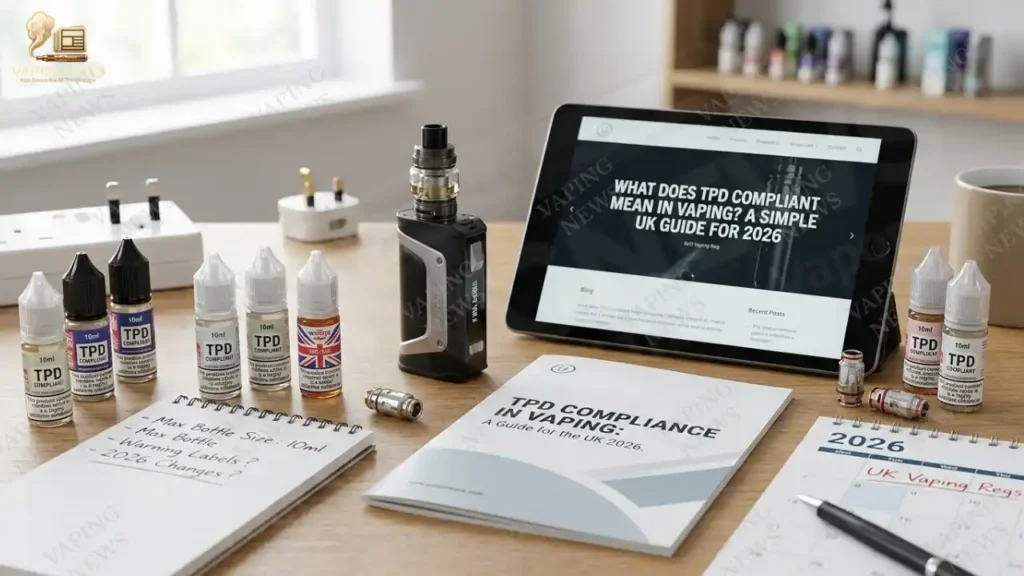
In the UK, “TPD-compliant” means a vape product meets legal standards. These standards are set by vaping regulations. This allows it to be legally sold in the United Kingdom. These rules ensure that vapes are safe and of high quality. These regulations are designed to ensure safety and quality for consumers.
Ever seen the phrase “TPD compliant” on a vape product and wondered what it means? You’re in the right place. This guide explains it all in plain language. To be TPD compliant, a vape must follow several rules. These include limits for nicotine strength and the capacity of tanks or pods. The rules also set limits on the size of e-liquid bottles containing nicotine.
TPD compliance is one part of the wider regulatory framework for vaping products. Wikipedia also outlines how electronic cigarettes are regulated across different countries and markets.
At Vaping News, we explain how to check whether the vape you are buying is genuinely legal in the UK.
This guide covers:
- What TPD and TRPR mean.
- The rules that apply to every vape product sold in the UK.
- Why the disposable vape ban happened.
- What products are still legal?
- How to verify a vape is compliant.
- How to spot a counterfeit.
- What is changing for UK vapers in October 2026?
What Does TPD Compliant Actually Mean for UK Vapers?
TPD stands for Tobacco Products Directive. This is the European Union legislation that governs vape products. It established the original regulatory framework for vape products across all member states. When the UK left the EU, it did not abandon these rules. Instead, the UK retained these rules under domestic law. This law is the Tobacco and Related Products Regulations 2016, commonly referred to as TRPR.
This is a crucial step before it can be legally sold in the UK. It is not a marketing phrase. It is a statement that the product has gone through a formal compliance process.
When you see TPD compliant on a product or a retailer listing, it means that the product has cleared this process. It also ensures your vape meets the legal standards designed to protect UK consumers.
TRPR stands for Tobacco and Related Products Regulations, the UK rules that regulate vaping products and e-liquids.
In order for a vaping product to be legally sold in the UK, it must comply with these regulations, which have been integrated into domestic law as the Tobacco and Related Products Regulations 2016 (TRPR). The TRPR outlines strict guidelines that all vaping products must adhere to before they can be marketed and sold in the UK market.
The UK TPD Rules Every Vaper Should Know: What Is and Is Not Legal
The rules are not complicated once they are laid out clearly. Here is every core need that applies to vape products legally sold in the UK.
Nicotine strength limit
The largest legal nicotine concentration in any e-liquid sold in the UK is 20mg per ml, which is equal to 2 per cent. Anything above this is illegal regardless of where it was manufactured or how it is labelled. This applies to nic salts and freebase liquids. It also includes prefilled pods and every other nicotine-containing format on the market. Products commonly seen in the US market labelled at 50mg or 5 per cent nicotine are not legal for sale in the UK.
Why UK Vape Regulations Exist: The Real Reasons Behind TPD Rules
Most TPD guides list the rules. Very few explain why the rules exist. Understanding the reasoning makes compliance feel less arbitrary and helps you make better decisions as a buyer.
Why the 20mg nicotine limit exists
High nicotine concentrations above 20mg carry a significantly greater addiction risk. They can also cause nausea, dizziness, and acute discomfort, particularly for new users and younger people.
The 20mg limit reduces addiction risk. It still provides enough nicotine to help smokers switch from cigarettes.
A 20mg nic salt with a tight MTL draw delivers nicotine effectively for most ex-smokers.
It does this without exposing users to unnecessarily high concentrations. These high concentrations have no therapeutic justification.
Why MHRA registration exists
This registration ensures that every product on the UK market is independently assessed. The assessment covers its contents and emissions.
It also creates a permanent, traceable record. This allows regulators to act if safety concerns arise after a product reaches consumers.
Without this system, the UK vape market would have no way to identify unsafe products. It would also be impossible to remove them from the supply chain.
UK Vape Laws After Brexit: Does TPD Still Apply in 2026?
Yes, TPD rules still fully apply in the UK in 2026. This is one of the most persistent misunderstandings in the UK vape market.
When the UK left the EU, it retained the Tobacco and Related Products Regulations 2016 as domestic UK law. Brexit changed who enforces the rules, not what the rules are.
There is one important longer-term implication worth understanding. The UK and EU now legislate independently. This means the rules may diverge over time as each jurisdiction updates its framework separately.
A product that meets EU TPD requirements is not automatically legal in the UK. It must also go through a separate UK notification process to meet MHRA requirements.
An illegal or legal UK vape product typically shows one or more of the following:
Nicotine strength above 20mg, such as 50mg or 5 per cent products designed for US markets. A sealed large nicotine tank with no refill mechanism in a device that cannot be recharged.
Missing or inadequate health warnings. No ECID number on the packaging. Packaging without child-resistant features. Buy through an unverified online marketplace listing with no traceable retailer.
| Legal UK Vape | Illegal UK Vape |
|---|---|
| Nicotine at 20mg or less | Nicotine above 20mg |
| 2ml pod or tank | Oversized sealed tank |
| 10ml nicotine bottle | Large nicotine bottle |
| MHRA is registered with ECID | No registration or ECID |
| Full packaging warnings | Missing or inadequate warnings |
| Verified UK retailer | Unverified marketplace source |
What TPD Rules Actually Mean for UK Vapers Day to Day
Regulations on paper can feel abstract. Here is what they actually mean for the practical experience of vaping in the UK in 2026.
The 2ml pod limit means you refill your pod more frequently than you would if no restriction existed. For most moderate users on a standard pod kit, this means topping up once or twice a day, depending on usage. It becomes habitual quickly and is rarely experienced as a meaningful inconvenience once you are used to the rhythm.
The vape tax arriving in October 2026 means e-liquid costs will increase for UK vapers regardless of the format they use. It’s worth planning your buying habits around this change before it comes into effect. This is particularly important if you use high volumes of e-liquid each week.
A Plain Summary
TPD compliance is not a marketing badge. The product is then formally registered with the UK regulator before it reaches the shelf. It is the line between a product that is accountable to a legal framework and one that is not.
For most UK vapers in 2026, the practical summary is straightforward. Buy from established UK retailers that you can verify. Look for the ECID number on packaging before you use a new product. Check the MHRA database if anything feels uncertain.
The UK vape market has changed significantly since the June 2025 disposable ban, and it will change again when the vape tax arrives in October 2026. TPD compliance remains the consistent standard through all these changes. It separates the products worth buying from the ones worth avoiding.
Vaping News will continue updating this guide as UK vaping regulations develop throughout 2026 and beyond.